Showing posts with label Book Announcement. Show all posts

October 31, 2016

Will Phelan Wins 2016 Book Prize of the Political Studies Association of Ireland


 We are very pleased to pass on the news that network member Will Phelan (Trinity College Dublin) has been awarded the 2016 Brian Farrell Book Prize by the Political Studies Association of Ireland for the best book published in political science by a PSAI member in 2015. He won the award for In Place of Inter-State Retaliation: The European Union's Rejection of WTO-style Trade Sanctions and Trade Remedies (OUP). Congratulations Will! For those interested, the publisher's blurb is below and more information can be found here.

* * *
Unlike many other trade regimes, the European Union forbids the use of inter-state retaliation to enforce its obligations, and rules out the use of common 'escape' mechanisms such as anti-dumping between the EU member states. How does the EU do without these mechanisms that appear so vital to the political viability of other international trade regimes, including the World Trade Organization? How, therefore, is the European legal order, with the European Court of Justice at its centre, able to be so much more binding and intrusive than the legal obligations of many other trade regimes?

This book puts forward a new explanation of a key part of the European Union's legal system, emphasising its break with the inter-state retaliation mechanisms and how Europe's special form of legal integration is facilitated by intra-industry trade, parliamentary forms of national government, and European welfare states.

It argues first that the EU member states have allowed the enforcement of EU obligations by domestic courts in order to avoid the problems associated with enforcing trade obligations by constant threats of trade retaliation. It argues second that the EU member states have been able to accept such a binding form of dispute settlement and treaty obligation because the policy adjustments required by the European legal order were politically acceptable. High levels of intra-industry trade reduced the severity of the economic adjustments required by the expansion of the European market, and inclusive and authoritative democratic institutions in the member states allowed policy-makers to prioritise a general interest in reliable trading relationships even when policy changes affected significant domestic lobbies. Furthermore, generous national social security arrangements protected national constituents against any adverse consequences arising from the expansion of European law and the intensification of the European market.

The European legal order should therefore be understood as a legalized dispute resolution institution well suited to an international trade and integration regime made up of highly interdependent parliamentary welfare states.

August 24, 2016

Book Announcement: Interparliamentary Cooperation in the Composite European Constitution (Nicola Lupo and Cristina Fasone, eds.)


Network member Nicola Lupo (LUISS), together with Cristina Fasone (also LUISS), have alerted us that their new edited volume Interparliamentary Cooperation in the Composite European Constitution has now appeared from Hart. Below is the publisher's blurb and more information, including the Table of Contents (noting several contributions by other network members), can be found here. Hart has graciously offered readers a 20 per cent discount if they choose to purchase (see here -- use code CV7 at checkout to get the discount).

* * *

This collection analyses the place and the functioning of interparliamentary cooperation in the EU composite constitutional order, taking into account both the European and the national dimensions. The chapters join the recent scholarship on the role of parliaments in the EU after the Treaty of Lisbon.The aim of this volume is to highlight the constitutional significance of interparliamentary cooperation as a permanent feature of EU democracy and as a new parliamentary function as well as to investigate the practical side of this relatively new phenomenon. To this end the contributors are academics and parliamentary officials from all over Europe.

The volume discusses the developments in interparliamentary cooperation and its implications for the organisation and procedures of national parliaments and the European Parliament, for the fragmented executive of the EU, and for the democratic legitimacy of the overall EU composite Constitution. These issues are examined by looking at the European legislative process, the European Semester and the Treaty revisions. Moreover, the contributions take into account the effects of interparliamentary cooperation on the internal structure of parliaments and analyse the different models of interparliamentary cooperation, ie from COSAC to the new Interparliamentary Conference on Stability, Economic Coordination and Governance in the European Union provided by the Fiscal Compact.

December 13, 2015

Two New Books from Alberto Alemanno, "Nudge and the Law" and "Regulating Lifestyle Risks"

Network member Alberto Alemanno (HEC-Paris) has let us know that he has two new collective volumes out.  The first, Nudge and the Law: A European Perspective, co-edited with Anne-Lise Sibony (Louvain) and with a Foreword by Cass Sunstein (Harvard), has appeared from Hart.  The second, Regulating Lifestyle Risks: The EU, Alcohol, Tobacco and Unhealthy Diets, co-edited with Amandine Garde (Liverpool), has appeared from Cambridge.  The publishers' blurbs are below and more details can be found here and here.

* * *

Behavioural sciences help refine our understanding of human decision-making. Their insights are immensely relevant for policy-making since public intervention works much better when it targets real people rather than imaginary beings assumed to be perfectly rational. Increasingly, governments around the world are keen to rely on those insights for reshaping public interventions in a wide range of policy areas such as energy, health, financial services and data protection. When policy-making meets behavioural sciences, effective and low-cost regulations can emerge in the form of default rules, smart disclosure and simplification requirements. While behaviourally-informed intervention has a huge potential for policymaking, it also attracts legitimacy and practicability concerns. Nudge and the Law takes a European perspective on those issues and explores the legal implications of the emergent phenomenon of behavioural regulation by focusing on the challenges and opportunities it may offer to EU policy-making and beyond. 


This collection of essays looks at the role the European Union could and should play in promoting healthier lifestyle, in light of the moral, philosophical, legal and political challenges associated with the regulation of individual choices. By tackling the main non-communicable diseases (NCD) risk factors (tobacco consumption, harmful use of alcohol, unhealthy diets and lack of physical activity), the contributors endeavour to identify common themes and determine whether and, if so, to what extent the lessons learned in relation to each area of EU intervention could be transposed to the others. By focusing on the European Union legal order, the book highlights both the opportunities that legal instruments offer for NCD prevention and control agenda in Europe, as well as the constraints that the law imposes on policy-makers.

November 18, 2015

Book Announcement: Antoine Vauchez, Democratizing Europe (Palgrave 2015)


We are delighted to announce that network member Antoine Vauchez (Paris) has released the English translation of his book Democratizing Europe with Palgrave Publishing.  A German translation is planned for 2016.  The publisher's blurb is below; further details are available here.

* * *

How can we account for numerous and repeatedly failed attempts to redress the European Union's democratic deficit over the past three decades? In the wake of the Eurozone crisis, Democratizing Europe argues that part of our collective failure to re-orient the EU's trajectory lies in our failure to fully characterize the EU government's dependent path. Bringing together new streams of scholarship in history, law, sociology, and political science, this book suggests a new portrait of the EU's singular political model. Tasked with Europe's grand project, the edification of a unique economic and monetary Market, the European Court, Commission, and Central Bank have been the cradle in which the EU polity has been shaped, staged, and legitimized. In this context, it is no wonder that the many attempts to parliamentarize Europe have had limited democratic effects. Vauchez suggests that we recognize this historically-rooted centrality of Europe's independent branch and adapt our democratization strategies accordingly.

November 17, 2015

Turkuler Isiksel on "Europe's Functional Constitution" at NYU's Jean Monnet Center (November 20, 2015) (RSVP required)

We are pleased to pass along to the network an invitation from NYU's Jean Monnet Center to join a celebration on Friday November 20, 2015, of a forthcoming book from network member Turkuler Isiksel (Columbia & currently Emile Noël Fellow at NYU): "Europe's Functional Constitution: A Theory of Constitutionalism Beyond the State" to be published by OUP in 2016.  

Turku will give a presentation on her forthcoming book; network members Joseph Weiler (EUI & NYU), Piet Eeckhout (UCL & currently Senior Emile Noël Fellow at NYU), and Daniel Francis (NYU), along with friend of the network Jan Klabbers (Helsinki & currently Senior Emile Noël Fellow at NYU), will comment.  Network member Gráinne de Búrca (NYU) will moderate the session.

Details follow; please note the RSVP request to jeanmonnet@nyu.edu.

* * *

Europe's Functional Constitution: A Theory of Constitutionalism Beyond the State

On Friday, November 20, 2015 at 12:30-2:00PM (lunch served from 12:00PM) the Jean Monnet Center will host Turkuler Isiksel‘s presentation of her forthcoming book Europe’s Functional Constitution: A Theory of Constitutionalism Beyond the State (coming out with OUP's Constitutional Theory series in 2016).

Commentators: Joseph Weiler, University Professor, NYU; President of EUI; Piet Eeckhout, Professor of EU Law, University College London; Senior Emile Noël Fellow, NYU School of Law, 2015-16, Johannes Klabbers, Professor of International Organizations Law, University of Helsinki; Senior Emile Noël Fellow, NYU School of Law, 2015-16, and Daniel Francis, JSD candidate, NYU School of Law.

Moderator: Gráinne de Búrca, Florence Ellinwood Allen Professor of Law, Faculty Director, Hauser Global Law School and Jean Monnet Center for International and Regional Economic Law & Justice.

Location: 1st Floor Lounge, 22 Washington Square North, New York, NY 10011.

Please kindly RSVP by email to jeanmonnet@nyu.edu if you would like to attend.

October 10, 2015

Frank Emmert Announces a New Article and a New Casebook Edition

Network member Frank Emmert (Indiana) has asked us to announce two new publications. First, his article "The Past, Present, and Future of EU Enlargement," co-authored with Sinisa Petrovic and published in the Fordham International Law Journal, is now available for free download here.  Second, "Cases and Materials on European Union Law," co-authored with network members Roger Goebel (Fordham), Eleanor Fox (NYU), and George Bermann (Columbia), as well as friends of the network Jefferey Atik (Loyola-LA) and Damien Gerard (Louvain), and published by West, is now in its fourth edition. The publishers' blurb is below; a table of contents is available here and further information is available here.  
* * *

Cases and Materials on European Union Law.  This classic casebook presents the governance and judicial structure of the European Union, together with its major substantive law fields of concern to students and practitioners, all as updated by the 2009 Treaty of Lisbon. Part I presents the history, institutional structure, principal Court constitutional doctrines, and its basic legal system. Teachers may choose among the other five parts to tailor their courses to their interests. Part II presents leading Court precedents and legislation intended to achieve the common market, later renamed the internal market. Part III comprehensively covers EU competition law and policy, of great concern to practitioners. The European Union’s external relations and trade policy is the subject of Part IV, while Part V presents the impact of free movement of capital and EU banking regulation, and the Monetary Union. Finally, Part VI presents several key policy areas—the harmonization of employment law, anti-discrimination rules, environmental protection, and civil and commercial litigation rules.

June 22, 2015

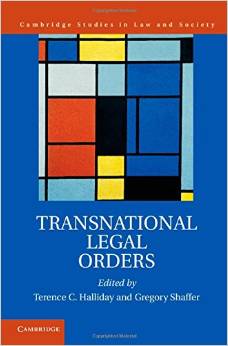
Book Announcement: Terence C. Halliday and Gregory Shaffer, eds., Transnational Legal Orders (Cambridge 2015)


Network member Gregory Shaffer (UC-Irvine) has alerted us that his new collective volume, edited together with Terence Halliday (ABF), entitled Transnational Legal Orders, is now out from Cambridge University Press.  The publisher's blurb is below and more details can be found here.


* * *

This book offers a path-breaking, empirically grounded theory that reframes the study of law and society. It shifts research from a predominantly national context to one that places transnational, national, and local lawmaking and practice within a single, coherent, analytic frame. By presenting and elaborating a new concept, transnational legal orders, Halliday and Shaffer present an original approach to legal orders that affect fundamental economic and social behaviors. The contributors generate arrays of hypotheses about how transnational legal orders rise and fall, where they compete and cooperate, and how they settle and unsettle. This original theory is applied and developed by distinguished scholars from North America, Europe, and Asia in business law (taxation, corporate bankruptcy, secured transactions, transport of goods by sea), regulatory law (monetary and trade, finance, food safety, climate change), and human rights law (civil and political rights, rule of law, right to health/access to medicines, human trafficking, criminal accountability of political leaders).

May 30, 2015

Book Announcement: Alicia Hinarejos, The Euro Area Crisis in Constitutional Perspective (OUP 2015)


Network member Alicia Hinarejos (Cambridge) has just published a new book with OUP.  Entitled The Euro Area Crisis in Constitutional Perspective, the book provides a comprehensive treatment of the complexities of European Economic and Monetary Union, and an account of the recent tribulations of the eurozone in the light of the key constitutional issues for the Union and the Member States alike.  The publisher's blurb is below; further information is available here.

* * *

The euro area sovereign debt crisis has been the greatest threat to the euro since its inception, but the consequences of the crisis go well beyond the realm of macroeconomics: the crisis has cast doubt on the viability of a mechanism of integration such as the one envisaged in Economic and Monetary Union ("EMU"), and on the future of the European Union as a political project in the face of citizens' growing disaffection. The various responses to the crisis have not only altered the principles underlying EMU; they have also had a profound impact on the constitutional orders of the EU and its Member States.

This book focuses on the euro area crisis and its aftermath from a constitutional perspective. It provides a critical analysis of the workings and evolution of Economic and Monetary Union, the changes brought by the crisis and their broader effects, and the constitutional obstacles to integration in this area. Looking forward, it tackles the uncertain future of economic and fiscal integration and the challenges posed. This is a compelling and incisive account of some of the most significant developments and dilemmas facing the European Union since its creation.

May 17, 2015

Book Announcement: Franciszek Strzyczkowski et al., eds., European Judicial Systems as a Challenge for Democracy (Intersentia 2015)


Network member Franciszek Strzyczkowski (University of Łódź), together with Elzbieta KuzelewskaDariusz Kloza, and Izabela Krasnicka, has just edited a new volume published by Intersentia, entitled European Judicial Systems as a Challenge for Democracy.  It forms part of the "European Integration and Democracy" series.  An extract from the Preface is below, and more details can be found here.


* * *

The European judiciary -- i.e., the Court of Justice of the European Union (CJEU), the European Court of Human Rights (ECtHR) and national courts interpreting and applying European law sensu largo -- have shaped [the process of European integration] actively, alongside the Founding Fathers, European nations, European states and their citizens. The involvement of the judiciary raises its own wide range of questions concerning the very nature of democracy. Much ink has already been spilled over issues such as democratic legitimacy, subsidiarity and accountability, the rule of law or judicial activism.

[In this volume,] seventeen scholars from across Europe . . . share their views on the European judiciary as a challenge for democracy. The various contributions to the present volume are split into two parts. The first provides ten chapters on the judicial systems of the European Union (EU), discussing, inter alia, recognition of democratic principles in the case law of the CJEU, contribution thereof to the democratisation of the Union and reception of EU law in the Member States. The second part discusses the judicial means [for the protection of] human rights in Europe, consisting of three chapters devoted to the promise of advisory opinions of the ECtHR as well as to democratic standards for voting and for fair trial[s].

March 25, 2015

Book Announcement: Michelle Egan, "Single Markets: Economic Integration in Europe and the United States"


Network member Michelle Egan (American University) has alerted us that her new book, Single Markets: Economic Integration in Europe and the United States, is now available from the Oxford University Press.  The publisher's blurb is below, and more information is available from the OUP site here.
***

This timely book provides in-depth analytical comparison of the nineteenth century evolution of the American single market with corresponding political, economic, and social developments in post-WWII European efforts to create a single European market. Building the regulatory framework needed for successful adoption of an integrated single market across diverse political units represents one of the most important issues in comparative political economy. What accounts for the political success or failure in creating integrated markets in their respective territories? When social discontent threatens market integration with populist backlash, what must be done to create political support and greater legitimacy?

Single Markets focuses on the creation of integrated economies, in which the United States and European Union experienced sharply contested ideas about the operation of their respective markets, conflict over the allocation of institutional authority, and pressure from competing political, economic, and social forces over the role and consequences of increased competition. Drawing upon four case studies, the book highlights the contestation surrounding the US and EU's efforts to create common currencies, expand their borders and territories, and deal with the pressures of populist parties, regional interests and varied fiscal and economic challenges. Theoretically, the book draws on work in European integration and American Political Development (APD) to illustrate that the consolidation of markets in the US and EU took place in conjunction with the expansion of state regulatory power and pressure for democratic reform.

Single Markets situates the consolidation of single markets in the US and EU in a broader comparative context that draws on research in economics, public administration, political science, law, and history.

March 20, 2015

Book Announcement: Antoine Vauchez, Brokering Europe: Euro-Lawyers and the Making of a Transnational Polity


Network member Antoine Vauchez (Paris I-Sorbonne/CNRS) has let us know that his book
L'Union par le droit has now appeared in English translation from Cambridge.  Entitled Brokering Europe: Euro-Lawyers and the Making of a Transnational Polity, the publisher's blurb is below and more details can be found on the CUP site here.

* * *

Since the 1960s, the nature and the future of the European Union have been defined in legal terms. Yet, we are still in need of an explanation as to how this entanglement between law and EU polity-building emerged and how it was maintained over time. While most of the literature offers a disembodied account of European legal integration, Brokering Europe reveals the multifaceted roles Euro-lawyers have played in EU polity, notably beyond the litigation arena. In particular, the book points at select transnational groups of multipositioned legal entrepreneurs which have been in a situation to elevate the role of law in all sorts of EU venues. In doing so, it draws from a new set of intellectual resources (field theory) and empirical strategies only very recently mobilized for the study of the EU. Grounded on an extensive historical investigation, Brokering Europe provides a revised narrative of the 'constitutionalization of Europe'.

March 4, 2015

Book Announcement: Kalypso Nicolaïdis et al., eds., Echoes of Empire: Memory, Identity and Colonial Legacies (Tauris 2015)


Network member Kalypso Nicolaïdis (Oxford), together with Berny Sebe and Gabrielle Maas, have edited a new volume from I.B. Tauris, entitled Echoes of Empire: Memory, Identity and Colonial Legacies.  The publisher's blurb is below and more information can be found on the Tauris site here.

* * *

How does our colonial past echo through today's global politics? How have former empire-builders sought vindication or atonement, and formerly colonized states reversal or retribution? This groundbreaking book presents a panoramic view of attitudes to empires past and present, seen not only through the hard politics of international power structures but also through the nuances of memory, historiography and national and minority cultural identities. Bringing together leading historians, poitical scientists and international relations scholars from across the globe, Echoes of Empire emphasizes Europe's colonial legacy whilst also highlighting the importance of non-European power centres- Ottoman, Russian, Chinese, Japanese- in shaping world politics, then and now. Echoes of Empire bridges the divide between disciplines to trace the global routes travelled by objects, ideas and people and forms a radically different notion of the term 'empire' itself. This will be an essential companion to courses on international relations and imperial history as well as a fascinating read for anyone interested in Western hegemony, North-South relations, global power shifts and the longue durée.

Book Announcement: Susan Rose-Ackerman et al., Due Process of Lawmaking: The United States, South Africa, Germany, and the European Union (CUP 2015)


Network member Susan Rose-Ackerman (Yale), together with Stefanie Egidy and James Fowkes, has a new book out from CUP entitled Due Process of Lawmaking: The United States, South Africa, Germany, and the European Union.  The publisher's blurb is below and more information can be found on the CUP site here.

* * *

With nuanced perspective and detailed case studies, Due Process of Lawmaking explores the law of lawmaking in the United States, South Africa, Germany, and the European Union. This comparative work deals broadly with public policymaking in the legislative and executive branches. It frames the inquiry through three principles of legitimacy: democracy, rights, and competence. Drawing on the insights of positive political economy, the authors explicate the ways in which courts uphold these principles in the different systems. Judicial review in the American presidential system suggests lessons for the parliamentary systems in Germany and South Africa, while the experience of parliamentary government yields potential insights into the reform of the American law of lawmaking. Taken together, the national experiences shed light on the special case of the EU. In dialogue with each other, the case studies demonstrate the interplay between constitutional principles and political imperatives under a range of different conditions.

Book Announcement: Kathleen Gutman, The Constitutional Foundations of European Contract Law (OUP 2014)


Network member Kathleen Gutman (KU Leuven) has alerted us to the appearance of her new book from OUP, The Constitutional Foundations of European Contract Law: A Comparative Analysis.  The publisher's blurb is below and more information can be found on the OUP website here.

* * *

Situated within the context of the ongoing debate about European contract law, this book provides a detailed examination of the European Union's competence in the field of contract law. It analyses the limits of Union competence in relation to several relevant Treaty provisions which potentially confer competence on the Union to adopt a comprehensive contract law instrument and the exercise of Union competence in connection with the operation of the principles of subsidiarity, proportionality and sincere cooperation. It also explores the viability of several alternative and complementary routes to the adoption of such an instrument, including enhanced cooperation, an intergovernmental treaty and certain American techniques. Setting forth an elaborate account of the context for this debate and its chronological development at the European level, this book charts the discussions relating to the European Union's competence to regulate contract law and offers a comparative analysis of the approach taken to the approximation of contract law in the American setting. Setting forth a detailed account of the context for this debate and its chronological development at the European level, the book charts the discussions that have occurred within and outside the EU relating to the transnational competence to regulate contract law. Situating European constitutional law within the continued debate about European contract law, it also reflects upon the contract law structure of the United States and examines the viability of alternative and complementary routes to the adoption of a comprehensive instrument of substantive contract law.

January 6, 2015

Book Announcment: Klemen Jaklic, Constitutional Pluralism in the EU (OUP)


Many of you may already know that network member Klemen Jaklic (Harvard) has a book out from OUP, Constitutional Pluralism in the EU.  What you may have overlooked was that it just received a very nice end-of-year review from Joseph Weiler (EUI) on EJIL: Talk, who called it "an important and tremendously useful book."  For readers seeking to learn more, the publisher's blurb is below and more information (including a downloadable Chapter One), can be found here.


* * *

Where does the law and political power of any given territory come from? Until recently it was believed that it came from a single and hierarchical source of constitutional authority, a sovereign people and their constitution. However, how can this model account for the new Europe? Where state constitutions and the European Constitution, which are ultimately equally self-standing sources of constitutional authority, overlap heterarchically over a shared piece of territory.

Constitutional pluralism is a new branch within constitutional thought that argues sovereignty is no longer the accurate and normatively superior constitutional foundation. It instead replaces this thought with its own foundation. It emerged on the basis of contributions by the leading EU constitutionalists and has now become the most dominant branch of European constitutional thought. Its claims have also overstepped the European context, suggesting that it offers historic advantages for further development of the idea of constitutionalism and world order as such.


This book offers the first overarching examination of constitutional pluralism.Comprehensively mapping out the leading contributions to date and solving the complicated labyrinth they currently form, Klemen Jaklic offers a complete assessment against existing and new criticisms while elaborating his own original vision. Constitutional pluralism thus refined has the potential to rightfully be considered the superior new approach within constitutional thought.

August 25, 2014

Book Announcement: Risk Governance of Offshore Oil and Gas Operations (Hempel Lindøe, Baram, and Renn, eds.)


Network member Michael Baram (BU) has asked us to alert the network to not one but two recent collective volumes on the topic of risk and governance of which he is the co-editor.  The first is Governing Risk in GM Agriculture, and the second is Risk Governance of Offshore Oil and Gas Operations, both from Cambridge.  The publisher's overview for the latter and more recent book is below, and more information can be found on the Cambridge site here.


* * *

This book evaluates and compares risk regulation and safety management for offshore oil and gas operations in the United States, United Kingdom, Norway, and Australia. It provides an interdisciplinary approach with legal, technological, and sociological perspectives on their efforts to assess and prevent major accidents and improve safety performance offshore. Presented in three parts, the volume begins with a review of the technical, legal, behavioral, and sociological factors involved in designing, implementing, and enforcing a regulatory regime for industrial safety. It then evaluates the four regulatory regimes that encompass the cultural, legal, and other contextual factors that influence their design and implementation, along with their reliance on industrial expertise and standards and the use of performance indicators. The final section presents an assessment of the resilience of the Norwegian regime and its capacity to keep pace with new technologies and emerging risks, respond to near miss incidents, encourage safety culture, incorporate vested rights of labor, and perform inspection and self-audit functions. This book is highly relevant for those in government, business, academia, and elsewhere in civil society who are involved in offshore safety issues, including regulatory authorities and industrial safety professionals.

August 13, 2014

Book Announcement: A Transatlantic Community of Law--Legal Perspectives on the Relationship between the EU and US Legal Orders (Fahey & Curtin, eds.)


We are pleased to announce the appearance of a new collective volume from Cambridge University Press, A Transatlantic Community of Law: Legal Perspectives on the Relationship between the EU and US Legal Orders, edited by network member Elaine Fahey (Amsterdam) along with her colleague (and friend of the network) Deirdre Curtin.  The book also includes a Foreword by network member Mark Pollack (Temple) and is of obvious interest to the readership here at europaeus|law.  An overview is below and more details can be found on the CUP page here.

* * *


As a medium for communication between the EU and the USA, law has the ability to provide unique insights into the state of contemporary transatlantic relations. A Transatlantic Community of Law offers legal perspectives on the emerging institutional characteristics of transatlantic relations and contemporary rule-making in both trade and security. Making use of rule of law analysis which has hitherto not been conducted in transatlantic relations scholarship, it draws together EU law, governance and rule-making scholarship and offers new ways of thinking about the use of law and contemporary transatlantic institutions.