Showing posts with label policy diffusion. Show all posts

February 8, 2016

Duina and Lenz on diffusion of legal and judicial designs across regional economic organizations

Network member Francesco Duina (University of British Columbia & Bates College) and co-author Tobias Lenz (European University Institute and Göttingen University) have just published an article in the Review of International Studies, entitled "Regionalism and diffusion revisited: From final design towards stages of decision-making."  The piece aims to refine the concept of diffusion of legal and judicial designs across regional economic organizations (such as the EU, Mercosur, NAFTA, etc.).  The abstract is below and the full article can be accessed here.

* * *

An emerging research programme on diffusion across regional international organisations (RIOs) proposes that decisions taken in one RIO affect decision-making in other RIOs. This work has provided a welcome corrective to endogenously-focused accounts of RIOs. Nevertheless, by focusing on the final design of policies and institutional arrangements, it has been conceptually overly narrow. This has led to a truncated understanding of diffusion’s impact and to an unjustified view of convergence as its primary outcome. Drawing on public policy and sociological research, we offer a conceptual framework that seeks to remedy these weaknesses by disaggregating the decision-making process on the ‘receiving’ side. We suggest that policies and institutional arrangements in RIOs result from three decision-making stages: problematisation (identification of something as a political problem), framing (categorisation of the problem and possible solutions), and scripting (design of final solutions). Diffusion can affect any combination of these stages. Consequently, its effects are more varied and potentially extensive than is currently recognised, and convergence and persistent variation in scripting are both possible outcomes. We illustrate our framework by re-evaluating research on dispute settlement institutions in the EEC, NAFTA, and SADC. We conclude by discussing its theoretical implications and the conditions that likely promote diffusion.
September 10, 2013

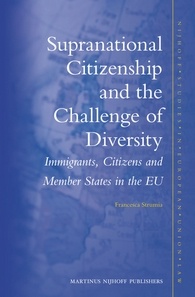
Book Announcement: Francesca Strumia, Supranational Citizenship and the Challenge of Diversity (Martinus Nijhoff)


Network member Francesca Strumia (University of Torino & Cleary Gottlieb/Milan) has let us know that her new book, Supranational Citizenship and the Challenge of Diversity: Immigrants, Citizens and Member States in the EU, has just appeared from Martinus Nijhoff Publishers.  More details can be found here and the publisher's blurb is below.  Congratulations Francesca.

* * *

In Supranational Citizenship and the Challenge of Diversity Francesca Strumia explores the potential of European citizenship as a legal construct, and as a marker of group boundaries, for filtering internal and external diversities in the European Union. Adopting comparative federalism methodology, and drawing on insights from the international relations literature on the diffusion of norms, the author questions the impact of European citizenship on insider/outsider divides in the EU, as experienced by immigrants, set by member states and perceived by “native” citizens. The book proposes a novel argument about supranational citizenship as mutual recognition of belonging. This argument has important implications for the constitution of insider/outsider divides and for the reconciliation of multiple levels of diversity in the EU.

June 25, 2013

Book Symposium (Opinio Juris): “The Democratic Foundations of Policy Diffusion” by Katerina Linos


A heads up that the international law blog Opinio Juris is hosting a book symposium on The Democratic Foundations of Policy Diffusion by network member Katerina Linos (Berkeley).  The symposium will include contributions by, inter alia, network members David Zaring (Wharton) and Anu Bradford (Columbia).  Check it out, and congratulations Katerina.