Showing posts with label citizenship. Show all posts

September 4, 2015

Ivana Isailovic (McGill) and Uladzislau Belavusau (VU Amsterdam) on the Léger Decision

New network member Ivana Isailovic (McGill) has written to share the contribution below, cross-posted from the European Law Blog. Entitled "Gay Blood: Bad Blood? A Brief Analysis of the Léger Case," and co-authored by Ivana and Uladzislau Belavusau (VU Amsterdam), the piece explores the ways in which the decision -- raising as it does complex and interrelated issues of sexuality, public health, discrimination, and citizenship -- constitutes a missed opportunity.

* * *
In April 2015, the Court of Justice delivered its judgment in Léger v. Ministre des Affaires sociales, de la Santé et des Droits des femmes; Etablissement français du sang. The case addressed the compatibility of national measures – here the French 2009 Ministerial Decree – permanently banning blood donations by men who had or have sexual relations with other men (MSM) with EU law. The Court found that these health policies could be justified in some circumstances, in light of the specific context prevailing in the Member State and the scientific knowledge and techniques available for detecting HIV in the early stages of contamination.

This judgment triggers a myriad of socio-legal questions pertaining to EU multi-level health governance, including the rising area of sexual risk regulation, as well as questions regarding EU sexual citizenship, and more particularly discrimination against LGBT individuals. The case, moreover, sheds light on the role scientific expertise plays in domestic and supranational courts and the interplay between legal discourse, scientific knowledge, rights, and identity politics. In this blog post, we offer a brief outline of the Court’s decision and highlight some of its controversial legal and normative aspects.
August 17, 2014

Special Issue of the German Law Journal -- "EU Citizenship: Twenty Years On"

Network member Russell Miller (W&L, also Editor-in-Chief of the German Law Journal), has passed on the announcement of a special issue entitled "EU Citizenship: Twenty Years On," edited by Patricia Mindus (Uppsala).  The announcement is below and the issues contents can be found here.

* * *

What does it mean to be a citizen of the European Union?  The question cuts right to the heart of the project of re-locating state authority at level of the supranational European Union.

On one hand, the dream seems to have failed to capture the European imagination.  The World Cup's old national rivalries and the opaque voting patterns that play-out each year at the Eurovision Song Contest tell the story of a stubborn identification with the nation state.  European Union leaders were relieved to see that voter turnout in last spring's European election did not follow the decades-old trend of declines.  But turnout held steady at a mere 43%, leaving Guy Verhofstadt to celebrate the fact that “We have finally broken the downward trend of falling participation in European elections."

On the other hand, European citizenship resonates in its way, as any of us who wearily queue in the long, slow-moving "All Nationalities" or "All Other Passport" lines at European airports know all too well.  And the Internet is bursting with offers to sell EU citizenship for the pricy sum of GBP 150,000 (the market seems to be most active in Malta and Bulgaria).

Patricia Mindus of Uppsala University has assembled a special issue on European Citizenship - marking the 20th anniversary of the introduction of the concept in the Maastricht Treaty - that treats the question in all its complexity.  Prof. Mindus explains that "Much has happened in and across the EU since Union citizenship was first introduced. Though many question its value, few advocate its irrelevance. This special issue takes stock of how EU citizenship has evolved over the last two decades and what ideas it conveys into the future."  The German Law Journal is very pleased to publish this impressive collection.

September 10, 2013

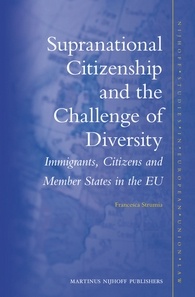
Book Announcement: Francesca Strumia, Supranational Citizenship and the Challenge of Diversity (Martinus Nijhoff)


Network member Francesca Strumia (University of Torino & Cleary Gottlieb/Milan) has let us know that her new book, Supranational Citizenship and the Challenge of Diversity: Immigrants, Citizens and Member States in the EU, has just appeared from Martinus Nijhoff Publishers.  More details can be found here and the publisher's blurb is below.  Congratulations Francesca.

* * *

In Supranational Citizenship and the Challenge of Diversity Francesca Strumia explores the potential of European citizenship as a legal construct, and as a marker of group boundaries, for filtering internal and external diversities in the European Union. Adopting comparative federalism methodology, and drawing on insights from the international relations literature on the diffusion of norms, the author questions the impact of European citizenship on insider/outsider divides in the EU, as experienced by immigrants, set by member states and perceived by “native” citizens. The book proposes a novel argument about supranational citizenship as mutual recognition of belonging. This argument has important implications for the constitution of insider/outsider divides and for the reconciliation of multiple levels of diversity in the EU.

April 1, 2013

Doubting the Essence of European Citizenship

This post is co-authored by network members Fernanda Nicola (American University, Washington College of Law) and Francesca Strumia (University of Torino & Cleary Gottlieb Steen & Hamilton/Milan).  

* * *

On Monday, March 25, 2013 the Washington College of Law, American University, as part of the school Founders’ Event, hosted a workshop entitled Doubting the Essence of EU Citizenship. The panel of five renowned speakers, including four network members, brought several intellectual tools to the table, from jurisprudence to legal and European integration theory, to investigate the essence of European citizenship. The contributions yielded a multi-perspective dialogue on the prospects of supranational citizenship. We distill in the following a few thoughts from that dialogue, in the attempt to offer a brief panorama of the points of view expressed by the panel.

March 23, 2013

Event: "Doubting the Essence of EU Citizenship" at American University, Washington College of Law, March 25, 1:30 pm

We're pleased to pass on the announcement of the panel below, which will examine the complex topic of European citizenship.  The discussion will take place on Monday, March 25, at 1:30 pm. at American University, Washington College of Law, Rm. 603 (details below).  The panel includes three members of the network, Francesca Strumia (Torino and Clear Gottlieb/Milan), Catherine McCauliff (Seton Hall), and Alexander Somek (Iowa and LAPA Fellow/Princeton), as well as network members Takis Tridmas (Queen Mary/London and Penn State) as commentator and Fernanda Nicola (AU/WCL) chairing.  If you are in the DC area and wish to attend, you can register here (free but required). If you can't attend in person but want to follow the discussion, it will be webcast here.  We look forward to hearing more about the discussion in future posts.